
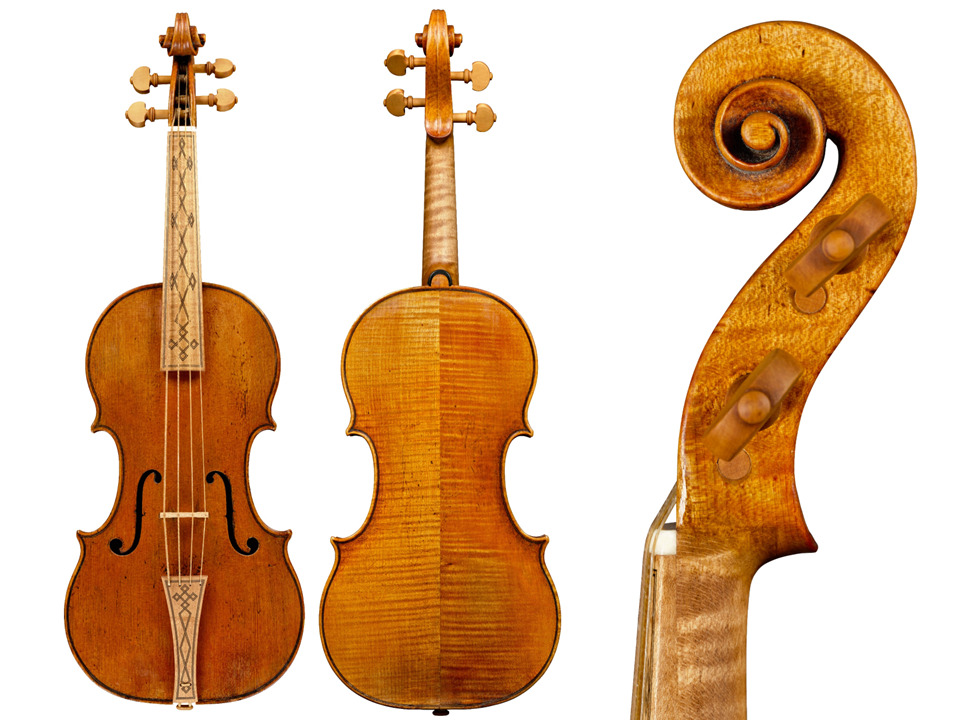
Almost all the masterpieces of classical violin making, including those on display at the Musco del Violino, have been adapted, during their long lives, to the changing musical requirements of composers and performers, with the replacement of certain parts such as the neck – while retaining the original scroll, the fingerboard, the tailpiece, the bridge, the pegs and the strings, in an organic process of evolution that forms part of the very cultural history of the violin. One of the very few instruments spared such ‘modernisation’ is the beautiful tenor viola made by Antonio Stradivari in 1690 for the Medici court, on display at the Galleria dell’Accademia in Florence, whose preparatory drawings are preserved in the room of the Museo del Violino dedicated to artefacts from the Master’s workshop.
Few instruments have been restored in the contemporary era, with the reconstruction of accessories and parts removed over time to return them to the condition that is believed to be typical of ‘Baroque’ Cremonese violin-making practice. The Nicolò Amati ex-Hepton violin is one such instrument: crafted at the height of the ‘master of masters’ of the Cremonese tradition, based on the smaller of the two models used in the family workshop, it has recently been the subject of in-depth studies and restoration work aimed at recreating a possible appearance and sound consistent with the original instrument, that was never lost but had changed over long periods of use. In particular the proposed design features a neck nailed to the body – with a wedge-shaped, shortened maple fingerboard decorated with inlaid purfling – and the use of ‘bare’, uncoated gut for all the strings.
The instrument owes its name to Sir Wilfred Hepton, mayor of the British city of Leeds, who owned it between the 19th and 20th centuries. Among its owners, the American Melvin Ritter stands out: he was concertmaster of the St Louis Symphony Orchestra and kept the violin from the mid-20th century until his death in 2012. This is not the first time this Amati has returned to Cremona; in 1937, it was selected from among the instruments on display at the landmark exhibition organised to mark the bicentenary of Antonio Stradivari’s death.