
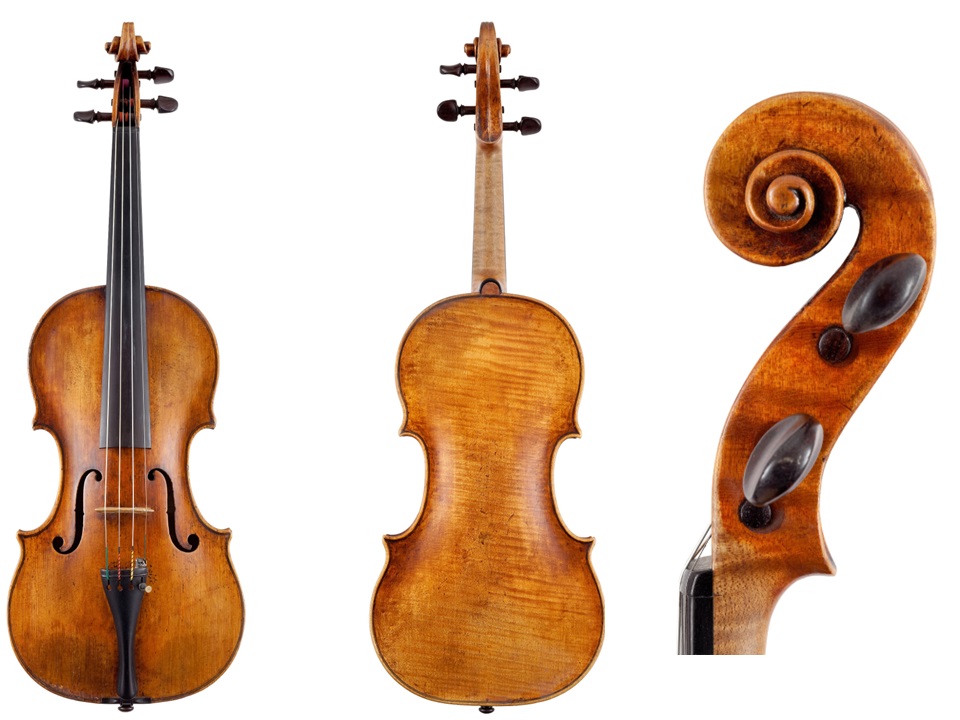
Girolamo II Amati (1649-1740) found himself carrying on the business of his famous family workshop at a time of fierce competition, during a life marked by numerous difficulties and personal tragedies.
His father Nicolò, who survived the terrible plague epidemic that wiped out an entire generation of violin makers between Cremona and Brescia in the 1630s, had to employ a large number of apprentices over the years to meet the demand for instruments resulting from this monopoly situation. The luthiers trained in various capacities in the Amati workshop, including Andrea Guarneri, Francesco Rugeri, their sons and Antonio Stradivari, were the ones who fuelled the competition faced by the young Girolamo when, after working alongside his elderly father in his final years, he took over the historic workshop.
With his exceptional technical skill, Girolamo (known as ‘the second’ to distinguish him from his paternal grandfather of the same name) assimilated the stylistic example of his ancestors, integrating it with that received in his training years from the assistants in the Amati workshops, among whom Giovanni Battista Rogeri, as well as with the inspiration derived from his proximity to his illustrious competitors.
Unfortunately, these years of transition were marked by bereavement: in 1685. just one year after Nicolò’s death, his young wife Angela Carettoni died; two years later, their eldest son, aged only three, tragically passed away.
Skill alone was not enough to maintain the workshop’s supremacy: during the same period, numerous commissions from the most important representatives of the clergy and European nobility marked the unstoppable rise of Antonio Stradivari, who, from then on, would be the undisputed leader of Cremonese violin making for almost half a century.
Girolamo, overwhelmed by debt, left Cremona shortly before 1700. He returned permanently only after about twenty years, continuing to make violins sporadically. His death in 1740 marked the end of the Amati family’s history, which had begun two hundred years earlier with the legendary figure of his great-grandfather Andrea.
The Brunner violin, dated c.1670, was made during the period when Girolamo’s contribution to the workshop began to be predominant. Built on the small Amati model, it bears witness not only to the technical virtuosity of its maker but also to his personal stylistic conception, evident in the construction of the edges and the purfling.
Owned by violinist and music educator Helen Brunner, it is temporarily on display in Cremona as part of the Friends of Stradivari project.