
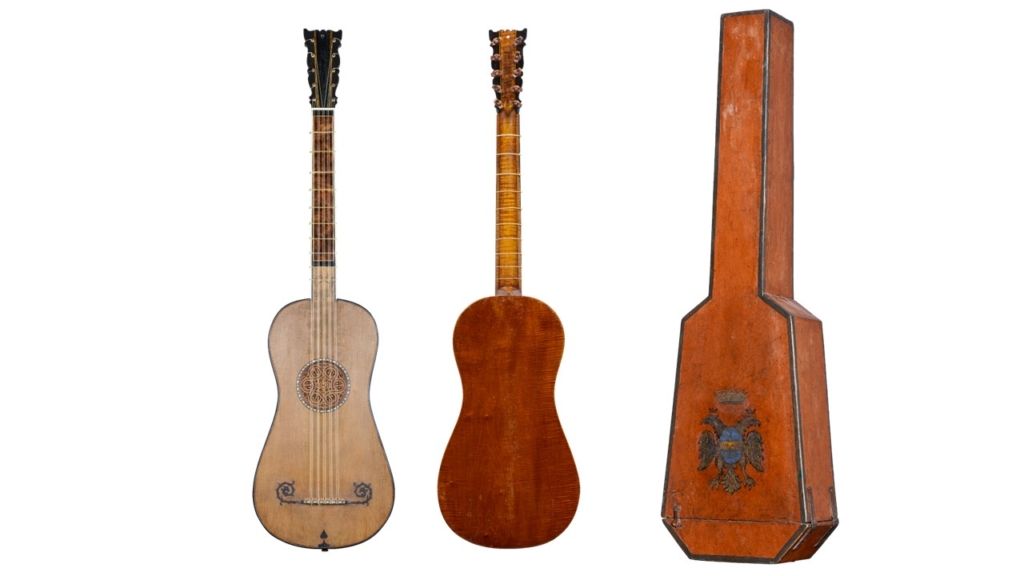
Although Antonio Stradivari is renowned for his production of stringed instruments, throughout his long career he devoted himself with equal dedication and a spirit of innovation to plucked string instruments. Unfortunately, very few examples have survived: just two mandolins, a harp, a lute body and five guitars, which today represent an extremely rare insight into this aspect of the great master’s work. The importance and scope of the workshop’s interest in plucked string instruments are evidenced by the numerous artefacts preserved in Room 6, which include patterns and drawings for the production of lutes, theorboes, and various types of mandolins and guitars.
Among the latter, the Giustiniani made in 1684 captivates and amazes. Its history can be traced back to its first owners, the Giustiniani family of Venice, who purchased it directly from the famous Cremonese luthier. The family’s coats of arms are painted on the original case, which was also made in Stradivari’s workshop – a further element adding to the rarity and interest of this beautiful instrument. Like the other surviving examples, the Giustiniani deviates from some of the conventions of guitar-making of the period and is characterised by a particularly long neck and vibrating string.
From a stylistic and dimensional standpoint, Stradivari’s guitars deviate from coeval instruments, which feature a vibrating string of considerable length and in which echoes of the Renaissance guitar and Spanish vihuela traditions can be found.
The five-course guitar enjoyed extraordinary popularity in Spain, Italy and France, among both the aristocracy and the general public, throughout the 17th century. They are often made from precious materials, as we can also see in the Giustiniani, whose sound-hole is surrounded by a circular decoration made of bone inlays, similar in shape and arrangement to those seen on some of Stradivari’s decorated violins.
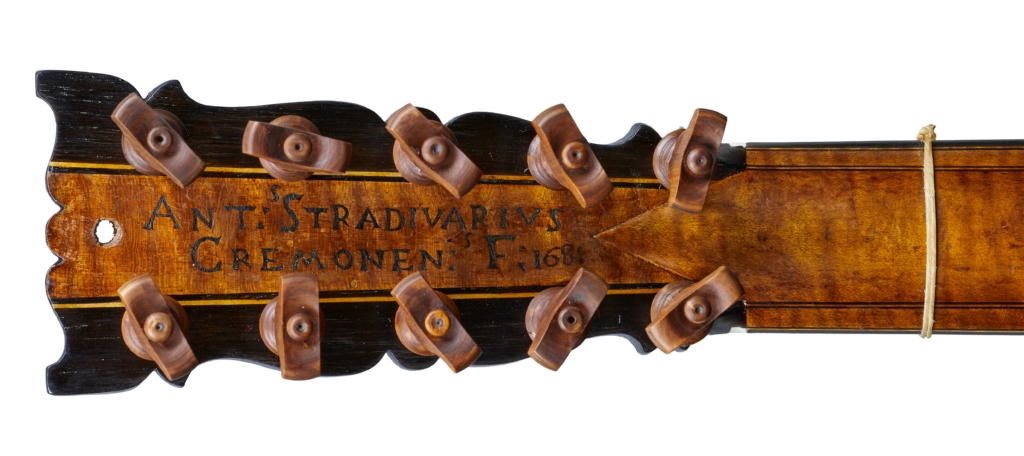
On the back of the headstock, one can read the luthier’s inlaid signature and the date of construction.
The Giustiniani guitar is owned by the Fondazione Giovanni e Mariella Accornero. It is temporarily on loan to the Museo del Violino as part of the ‘friends of Stradivari network.
 |